Trailing drawdown vs end-of-day drawdown, firm by firm
Nội dung này hiện chưa có sẵn bằng ngôn ngữ của bạn.
Every prop account has a level that ends it: the liquidation level, the balance at which the firm closes the account. The drawdown allowance says how far below your balance that level starts: $2,000 on most 50K futures accounts, so a new 50K evaluation fails at $48,000.
What differs from firm to firm, and between a firm’s own programmes, is how that level moves afterwards. There are three kinds, and the same trade can leave you with very different room under each.
Static: the level never moves
With a static drawdown the level stays where it started. On a 50K account with a $2,000 allowance it is $48,000 on the first day and on the last, however far up the account goes. A good week only adds room.
Static drawdowns are common at the forex and CFD firms, usually on their two-step challenges (FTMO’s 2-Step counts a 10% maximum loss on the initial balance), and rare among the futures firms.
Intraday trailing: the level follows your best moment
With an intraday trailing drawdown the level follows the highest point of your equity, open profit included, while the trade is still running. It never comes back down.
Take a 50K account with a $2,000 allowance. You buy, the trade runs $1,000 into profit, and you close it for $200:
- the peak equity was $51,000, so the level is now $49,000;
- your balance is $50,200, so your room is $1,200, not $2,200.
The $800 you gave back inside the trade cost you $800 of room for good. A trader who lets winners breathe pays for it under this rule; a trader who scales out early does not.
End-of-day trailing: the level follows your closing balance
With an end-of-day (EOD) trailing drawdown the level follows the highest closing balance of a trading day. What happens inside the day does not move it.
The same trade on an EOD account: the trade’s peak does not count, the day closes at $50,200, and the level moves to $48,200. Your room stays $2,000.
The level still applies during the day. It is set from the last close, and the account fails if the balance or the equity falls through it before the day ends. EOD accounts often come with a daily loss limit on top: Apex’s EOD Trail accounts have one that ends the day, Bulenox’s Option 2 one that pauses it.
Where the trailing stops
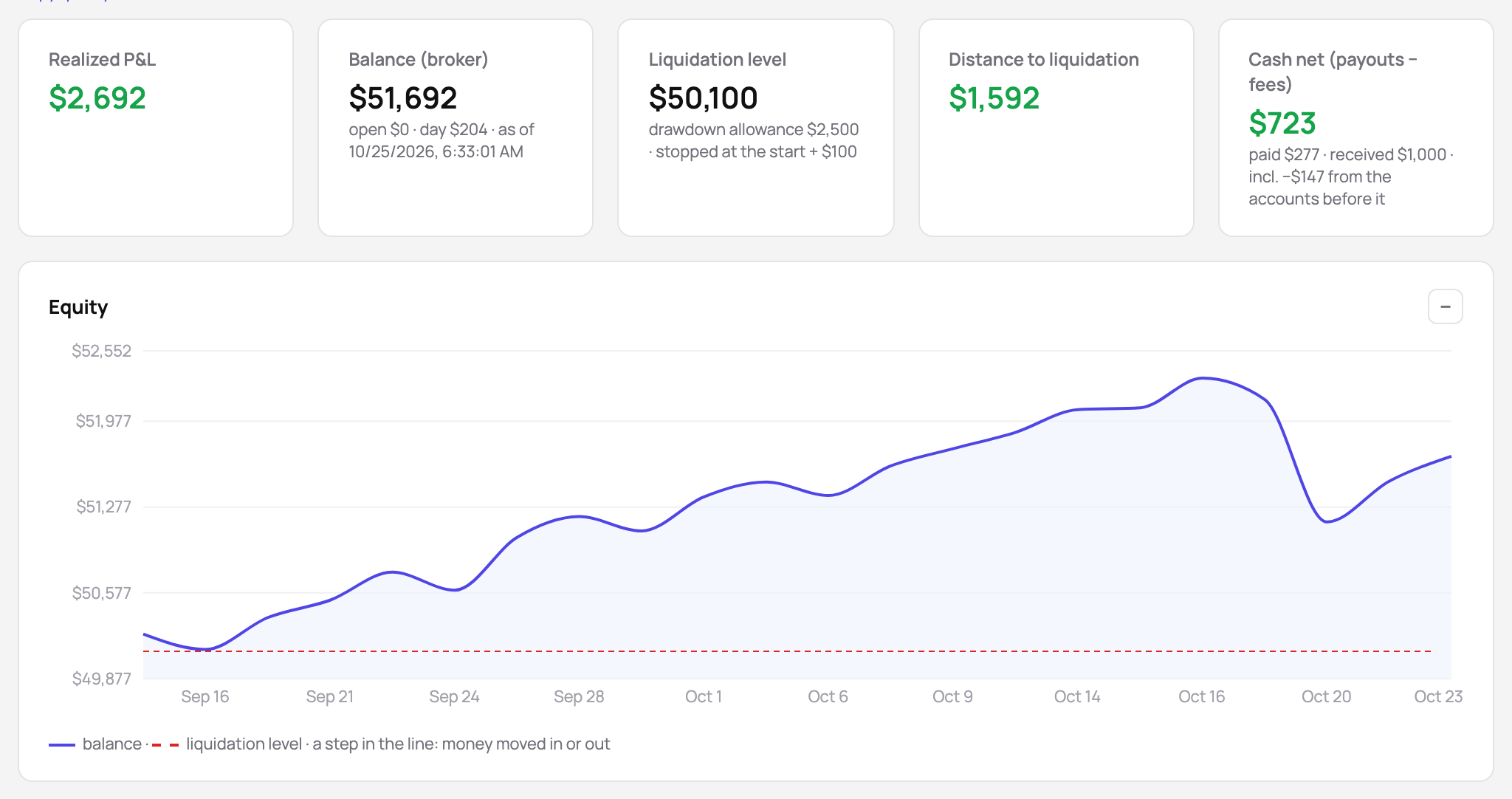
Most firms stop the trailing once the account is far enough up, so a funded account does not trail forever. Topstep’s level stops at the start balance: once you are $2,000 up on a 50K account, the level stays at $50,000. Apex’s funded (Performance) accounts stop at the start + $100, at $50,100. A few firms freeze the level at the first payout instead.
After that, the level is effectively static, and every dollar you make adds room.
Which futures firms use which
The drawdown kind of each firm’s 50K programmes, from TakeJournal’s catalogue of prop firm rules as checked against the firms’ own pages on October 20, 2026. Firms change their programmes often; each firm’s page on this site has the current list, its sizes and its rules.
| Firm | Intraday trailing | End-of-day trailing | Static |
|---|---|---|---|
| Apex Trader Funding | Intraday Trail, Legacy | EOD Trail | – |
| Topstep | – | Trading Combine | – |
| MyFundedFutures | Rapid (funded) | Rapid, Rapid EOD, Pro, Builder | – |
| Bulenox | Option 1 | Option 2 | – |
| Take Profit Trader | PRO | Test, PRO+ | – |
| Tradeify | – | Growth, Select, Lightning | – |
| Lucid Trading | LucidDaily (intraday) | LucidPro, LucidFlex, LucidDaily (EOD), LucidDirect | – |
| Alpha Futures | – | Zero, Standard, Advanced | – |
| Earn2Trade | Live funded | Trader Career Path, Gauntlet Mini, LiveSim | – |
| Elite Trader Funding | 1 Step | End of Day, Direct to Funded | Static |
| Top One Futures | Elite ACCESS Intraday (funded) | Elite Daily, Elite ACCESS, Instant Sim Funded, Ignite | – |
| TradeDay | Quick Pay (intraday) | Quick Pay (end of day), Fast Pass | – |
| Phidias Propfirm | – | Fundamental, Premium | Express to Live |
| FundedNext Futures | – | Flex, Rapid Pro, Rapid Daily | – |
| FTMO Futures | – | Growth, Pro | – |
| The5ers Futures | – | Day Trade, Swing | – |
| E8 Markets Futures | – | E8 Zero Starter, E8 Zero Max, E8 Signature | – |
Two things stand out. End-of-day trailing has become the default for futures evaluations, and the firms that still offer intraday trailing mostly offer it beside an EOD version of the same programme, so you can choose. The choice is worth making on purpose: if your trades often run well into profit before you exit, the intraday version charges you for every dollar you give back.
Keeping an eye on the level
The arithmetic above is easy for one trade and tedious for twenty accounts. TakeJournal keeps it for every account: from the start balance, the drawdown and the trades, it keeps the liquidation level and the distance to it. With an intraday trailing drawdown the level follows the open profit inside trades too, from the trade’s bars, the way the firm’s rule does, and every trade records the smallest distance it touched. Where the trailing stops, the level stops with it, and the account says so (“stopped at the start + $100”).
The Accounts page shows each account as a gauge against its allowance, the closest first, amber once the distance falls below three quarters of the allowance, and an alert tells you when an account has used 75% of it (the share is yours to change). Choosing the firm’s product sets the drawdown kind, the allowance and where the trailing stops for you.
The distance to liquidation, the intraday level and the alerts come with the Trader plan and above (pricing).
AI trả lời dựa trên hướng dẫn của chúng tôi: TakeJournal hoạt động thế nào, nhập dữ liệu, tài khoản quỹ prop, các gói.
Câu hỏi của bạn được gửi đến Anthropic để trả lời. Chúng tôi giữ cuộc trò chuyện 30 ngày để cải thiện hướng dẫn, rồi xóa nó. Đây không phải lời khuyên đầu tư. Chính sách quyền riêng tư