Consistency rules explained, firm by firm
Este conteúdo não está disponível em sua língua ainda.
You pass the profit target on a Thursday, and the evaluation is still not passed. Or the payout button stays grey although the account is well up. In both cases the reason is usually the same: the consistency rule, also called the best-day rule. It limits how large a share of your profit a single day may be.
Firms use it so that an account is passed or paid for a run of decent days, not for one lucky one. For a trader it is easy to break by accident, because the day that breaks it is your best day.
What the rule measures
The rule compares two numbers:
- the best day: the largest profit of one trading day in the period;
- the base: most firms take the profit of the period (since the account’s start, or since the last payout); a few take the profit target instead.
The rule is a share: under a 40% rule the best day may be at most 40% of the base. The trading day is the firm’s day, which for futures runs from 18:00 New York time to 17:00 the next day, so an evening fill belongs to the next day’s total.
Some firms count only the positive days’ profit as the base, which is stricter on an account that also has losing days: FTMO did until October 12, 2026, and its accounts ordered since then count the whole profit. A few count the best trade instead of the best day (Maven’s Instant Mini, for example). Read your firm’s wording once; the arithmetic below is the same.
In an evaluation: the target moves up
Take a 50K evaluation with a $3,000 target and a 50% consistency rule. On your third day you make $2,000. To keep that day at 50% of the profit, your total profit has to reach $4,000, not $3,000:
profit needed = best day ÷ the rule’s share = $2,000 ÷ 50% = $4,000
Under a 40% rule the same day asks for $5,000; under 30%, about $6,700. The evaluation does not fail. It simply goes on until the smaller days have diluted the big one, and every larger day moves the goal again.
Topstep states its Trading Combine rule against the target: the best day may be at most 55% of the target, so $1,650 on the 50K Combine’s $3,000, and a larger day raises the target to the day divided by 55%. A $2,000 day asks for about $3,640.
In a funded account: the payout waits
On a funded account the rule usually guards the payout. The period starts after your last payout, so every payout starts it again.
Take a funded account under a 40% rule. Since the last payout you made $2,500, and the best day was $1,200: 48% of the profit. The payout waits until the profit reaches $1,200 ÷ 40% = $3,000, $500 more without a larger day. Nothing fails; the money stays in the account until the rule is met, and a losing day in between pushes the payout further away.
Some firms change the share with the payout’s number: Bulenox’s Fast Track and Tradeify’s Lightning Funded allow 20% for the first payout, 25% for the second and 30% after that. Apex’s legacy Performance Accounts drop the 30% rule from the sixth payout on.
Which firms use which share
From TakeJournal’s catalogue of prop firm rules, as checked against the firms’ own pages on October 20, 2026. Of the 30 firms in the catalogue, 26 have a consistency rule on at least one programme. The share is of the period’s profit unless it says otherwise; “–” means no programme of that stage has one. Firms change their programmes often; each firm’s page on this site lists its current products and rules.
Futures firms
| Firm | Evaluation | Funded |
|---|---|---|
| Apex Trader Funding | – | 50% (Legacy 30%) |
| Topstep | 55% of the target | 40% on the Consistency payout path |
| MyFundedFutures | Rapid, Pro 50%; Rapid EOD 30% | Builder 50% |
| Bulenox | – | Master 40%; Momentum Master 35%; Fast Track 20–30% |
| Take Profit Trader | Test 50% | – |
| Tradeify | Select 40% | Growth 35%; Lightning 20–30% |
| Lucid Trading | LucidDaily 50%; LucidFlex 40% | LucidPro 40%; LucidDirect 20% |
| Alpha Futures | Standard 50%; Advanced 40% | Zero, Standard 40%; Direct 20% |
| Earn2Trade | 30% | – |
| Elite Trader Funding | – | Fast Track 30% |
| Top One Futures | Elite Daily 40% | Elite ACCESS 40%; Instant Sim Funded 20%; Ignite 15% |
| TradeDay | Quick Pay 30%; Fast Pass 45% | Fast Pass 45% |
| Phidias Propfirm | – | Fundamental, Premium 30% |
| FundedNext Futures | Flex 40% | Rapid Pro 40%; Direct 20% |
| FTMO Futures | Growth 40%; Pro 50% | – |
| E8 Markets Futures | E8 Zero 40% | E8 Signature 35% |
Forex and CFD firms
| Firm | Evaluation | Funded |
|---|---|---|
| FTMO | 1-Step 50% | 1-Step 50%; Instant 30% |
| FundingPips | – | Zero 15% |
| E8 Markets | – | E8 One 40%; E8 Signature 35% |
| Fintokei | StartTrader 40% of the target | – |
| Alpha Capital Group | – | Alpha One, Pro, Swing 40%; Alpha Direct 15% |
| FXIFY | Lightning 30% | Two Phase Classic 25%; Lightning 30%; Instant Funding Lite 20% |
| Maven Trading | – | Instant, Buy Now Pay Later 20%; Instant Mini 15% |
| Blue Guardian | Nano 50%; Futures Express, Reserve 40% | Nano 50%; Futures Standard 40%; Futures Direct 20–30% |
| FunderPro | One Phase 40%; Pro 45% | Instant 15% |
| Funded Trading Plus | 2-Step Classic 35% | 2-Step Classic 50% |
A pattern stands out: the accounts you buy already funded, with no evaluation (the Instant, Direct and Ignite accounts), carry the strictest rules, 15 to 20%. Their consistency rule does the work an evaluation would have done. On such an account a single good day can hold your first payout for weeks, so size it with the rule in mind.
Living with the rule
The rule rewards a smaller best day, not a smaller total. Three habits help:
- Know the number before the day ends. If today is about to become a best day far above the share, closing early costs less than the days it would take to dilute it.
- Count from the right start. After a payout the period starts again, and your old good days no longer help.
- Check the share, not the feeling. A day that feels average can still be 45% of a thin period’s profit.
Tracking it per account
Choose the firm’s product on an account in TakeJournal, and the account gets the firm’s consistency rule with the rest of its rules. The Firm rules card then shows the best day of the period, its share of the base, and how much more profit brings it under the limit; in an evaluation the profit target rises with the best day the way the firm counts it, and on a funded account the Payout row says in words what is still missing. The period starts the day after your last payout. An alert tells you when the best day goes over the limit.
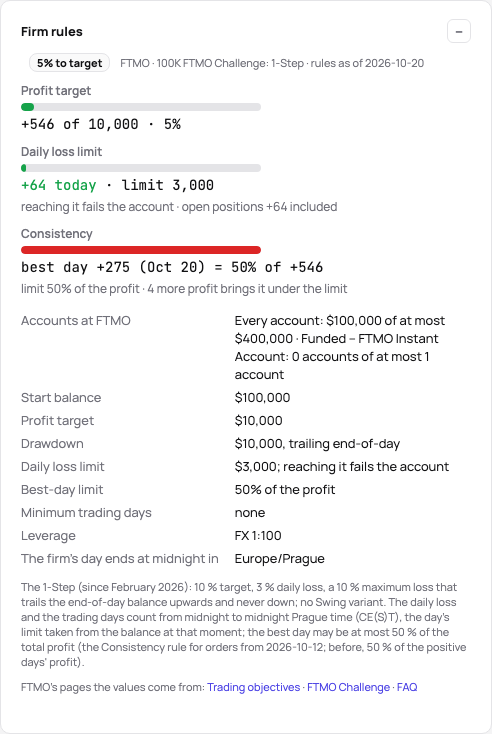
The firm rules and their alerts come with the Trader plan and above; the chance to pass, which plays an evaluation thousands of times with your own trading days against its rules, consistency included, with Pro and Fleet (pricing).
A IA responde a partir do nosso guia: como o TakeJournal funciona, as importações, as contas de mesas proprietárias, os planos.
Sua pergunta vai para a Anthropic para ser respondida. Guardamos a conversa por 30 dias para melhorar o guia e depois a apagamos. Sem recomendação de investimento. Política de privacidade